![200224_Airly_Logo_Lockup_White_RGB.png]](https://support.airly.org/hs-fs/hubfs/200224_Airly_Logo_Lockup_White_RGB.png?height=30&name=200224_Airly_Logo_Lockup_White_RGB.png)
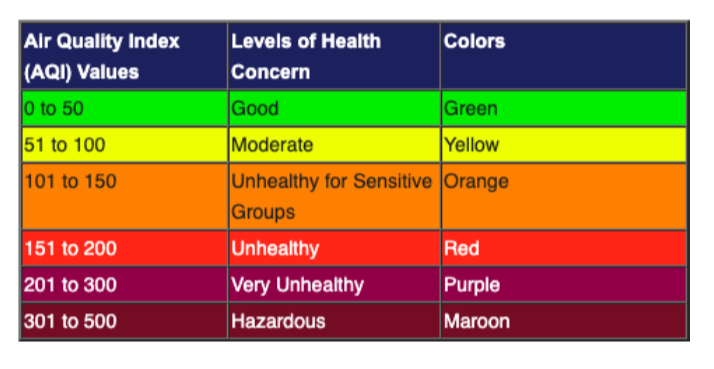
The Air Quality Index (AQI) is a crucial tool that quantifies and communicates the quality of the air we breathe by combining measurements of several pollutants into a single, easily understandable number. These pollutants mainly include particulate matter such as PM2.5 and PM10, as well as gases like ozone (O₃), nitrogen dioxide (NO₂), carbon monoxide (CO), and sulfur dioxide (SO₂). Concentrations of particulate matter are usually expressed in micrograms per cubic meter (µg/m³), while gases may be measured in parts per million (ppm) or parts per billion (ppb).
Different countries have their own air quality indices, corresponding to different national air quality standards.
The Environmental Protection Agency (EPA) shares the AQI with the public via its dedicated website.
The higher the index, the worse the air quality, which can affect health, especially for people with respiratory problems.